
Sitting your driving test can feel like the biggest hurdle standing between you and your licence. Good driving test preparation in Melbourne isn’t about memorising a single route – it’s about building the observation, control and decision-making skills that let you drive safely with other traffic, whatever the examiner throws at you on the day. This guide covers what the VicRoads drive test actually checks, how to structure your practice in the weeks beforehand, and where a driving instructor can genuinely make a difference.
Driving Test Preparation in Melbourne: What It Really Involves
Passing the drive test comes down to demonstrating consistent, safe driving, not performing a rehearsed sequence of moves. The test itself is made up of a pre-drive vehicle check followed by an on-road assessment, split into two stages, and you need to pass stage one before you’re assessed on stage two. Before you can even book, you’ll need to have completed and declared your logbook hours (if this applies to your licence pathway) and passed your Hazard Perception Test. Solid driving test preparation in Melbourne means working through these fundamentals early, rather than cramming in the final week, so safe habits feel automatic instead of effortful under pressure.
Key Skills to Practise Before Your Test
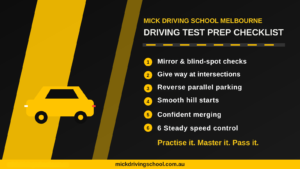
No two skills matter more than observation and consistency. In the weeks before your test, spend real time on:
- Mirror and blind-spot checks before every lane change, turn or park
- Matching your speed to the road conditions, not just the speed limit
- Giving way correctly at uncontrolled intersections and roundabouts
- Reverse parallel parking and three-point turns
- Smooth hill starts, without rolling back
- Merging confidently onto busier roads
The best driving test practice in Melbourne learners can get covers a mix of quiet residential streets, busy arterial roads and unfamiliar suburbs, because examiners want to see you handle changing conditions calmly rather than repeat a route you’ve memorised.
Common Mistakes Learner Drivers Make
Even confident learners lose marks on avoidable errors. The most common include:
- Forgetting to check blind spots, even when mirror checks look fine
- Hesitating too long at intersections, which can be marked much like failing to give way
- Rolling stops at stop signs instead of coming to a full, complete stop
- Poor lane positioning on multi-lane roads
- Stalling under pressure at lights or roundabouts
- Uneven acceleration or braking, which reads as a lack of vehicle control
Most of these come down to nerves rather than a genuine lack of knowledge, which is exactly why steady, repeated practice matters more than last-minute cramming.
Should You Take Professional Driving Test Preparation?
You don’t have to prepare alone. A qualified driving instructor in Melbourne learners trust can spot habits you don’t notice yourself – a mirror check that’s a fraction too slow, a tendency to coast into stop signs, or nerves that only surface once someone else is assessing you. Structured lessons and mock tests, such as our logbook training and test-preparation sessions, are built around identifying weak areas and correcting them before test day, rather than teaching to a single memorised route.
What to Do Before Test Day
- Book a lesson or two specifically focused on mock-test conditions
- Check your test vehicle meets VicRoads’ requirements – roadworthy, correct plates displayed, working indicators, wipers and demister
- Confirm your logbook hours are declared and your Hazard Perception Test is passed, where these apply
- Get a proper night’s sleep and eat something before your appointment
If you’re still searching for a driving instructor near me the week before your test, it pays to book early, since availability tightens around school holidays and exam periods.
What Happens on Test Day
Your VicRoads drive test has two parts: a pre-drive vehicle check, then an on-road assessment split into two stages. You must pass stage one before progressing to stage two, so nerves on simple early tasks, like mirror and indicator checks, can affect how the rest of the test unfolds. The on-road component takes you through a mix of traffic conditions to assess whether you’re ready to drive safely without supervision. Bring your learner permit and glasses if you need them for driving, along with a roadworthy vehicle that meets testing criteria, since the department does not supply vehicles for drive tests. Requirements are updated from time to time, so it’s worth checking the official Transport Victoria drive test page before your appointment.
Final Tips for Passing with Confidence
If you’re wondering how to prepare for driving test in Melbourne with confidence, the short answer is consistency: regular practice across different roads, honest feedback on your weak points, and enough lead-up lessons that test-day nerves don’t undo good habits. Searching for a driving school near me is often the first step, but look for one offering structured, test-specific preparation rather than general lessons only, so your final sessions actually build toward what the examiner will assess.
At Mick Driving School, our lessons are built around this same approach: identifying your weak areas, practising mock tests in real Melbourne traffic, and giving you honest, specific feedback before your appointment. If you’d like a hand getting test-ready, you can book a lesson, look into our logbook training if you’re still building up hours, or get in touch to talk through which package suits where you’re at.

