Choosing a driving instructor is one of those decisions that quietly shapes how confident you feel behind the wheel for years afterward. Get it right, and lessons build steadily on real skills. Get it wrong, and you can end up nervous or unprepared without quite knowing why. If you’re searching for the best driving school in Melbourne, you’re probably comparing instructors, prices, and reviews without much to actually judge them against. This article walks through what separates a good driving school from an average one, so you can decide based on what matters rather than whichever ad appears first.
What Makes a Driving School the Right Choice?
A best driving school in Melbourne isn’t defined by how many branches it has or how polished its ads are. It comes down to practical things: a qualified instructor who explains rather than just directs, a teaching approach that adapts to how you learn, a lesson structure where skills build on each other, and clear communication about costs and progress. A Melbourne driving school built around these fundamentals tends to produce more confident, better-prepared drivers than one built around volume and turnover.
Experience matters too, but not just years on the road. What counts is experience teaching: understanding why a learner freezes at a roundabout, or why merging onto a freeway feels different the tenth time than the first.
How to Choose the Best Driving School in Melbourne
There’s no single best school for everyone. The best driving school in Melbourne for a nervous adult returning to driving after years off is unlikely to suit a confident teenager preparing for their P’s. What you’re really doing is matching your needs to the right instructor and structure.
Start by considering:
- Whether the instructor specialises in beginners, nervous drivers, or test preparation
- Whether lessons are structured around a clear progression or booked ad hoc
- How instructors communicate, and whether they explain the reasoning behind instructions or just call out directions
- Whether the vehicle and dual controls are properly maintained
- How lesson times and locations are scheduled around Melbourne traffic patterns
None of this is easy to judge from a website alone, which is why a short phone conversation before booking is worth the ten minutes it takes.
What to Look for in a Driving Instructor
A good driving instructor in Melbourne combines three things: technical competence, teaching skill, and patience. Being a good driver doesn’t automatically make someone a good teacher – breaking driving down into steps, correcting mistakes without knocking confidence, and staying calm when a learner stalls at a busy intersection is a separate skill entirely.
Look for an instructor who:
- Explains the reasoning behind a manoeuvre, not just the steps
- Adjusts pace to your comfort level rather than a fixed lesson plan
- Gives specific, actionable feedback rather than vague praise or criticism
- Stays calm and constructive when things go wrong
Patience matters most for nervous or returning drivers, where confidence often needs rebuilding before skills can improve.
Consider the Type of Driving Lessons You Need
Not all learners need the same thing, and a good school offers more than a one-size-fits-all lesson plan.
- Beginners generally need slower-paced, foundational sessions covering vehicle control, road positioning, and hazard awareness before moving into busier traffic. Driving lessons for beginners in Melbourne should start on quieter residential streets before progressing to intersections and multi-lane roads.
- Nervous or returning drivers often benefit from an instructor who prioritises reassurance and gradual exposure over strict test-focused drilling.
- Learners preparing for their test need targeted practice on the manoeuvres and road conditions likely to come up, plus a realistic understanding of what the test actually assesses.
- Refresher lessons suit licensed drivers who want to rebuild confidence, particularly around freeway driving or complex intersections.
Booking driving lessons in Melbourne without first identifying which category you fall into often leads to lessons that don’t match your actual needs.
(Learners preparing for their test should also understand what the Victorian driving test assesses. The official VicRoads guidance is a useful reference before booking lessons.)
Don’t Compare Driving Schools on Price Alone
It’s tempting to sort every option by price and book whichever is cheapest, but the hourly rate alone rarely tells you much about lesson quality. A lower price sometimes reflects an efficient, well-run business, and sometimes reflects less experienced instructors, older vehicles, or a higher turnover of students per instructor.
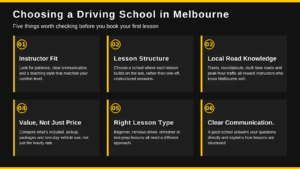
When comparing costs, ask what’s actually included: is pickup and drop-off covered, are packages structured around a clear progression, and does the price include use of the vehicle on test day? An affordable driving school in Melbourne can still offer strong instruction, since affordability and quality aren’t mutually exclusive, but affordable should mean fair value delivered, not simply the lowest number on the page.
Why Local Melbourne Driving Experience Matters
Melbourne’s road network has its own quirks, and an instructor who knows them well can prepare you for situations a generic lesson plan won’t cover. Tram-related road rules are a good example: many learners have never had to think about giving way to a tram or waiting behind one at a stop, and getting this wrong is a common source of test-day anxiety.
Beyond trams, local knowledge helps with:
- Navigating multi-lane roads and roundabouts common across the inner and middle suburbs
- Managing peak-hour traffic on routes learners are commonly tested on
- Practising parallel parking in real, busy conditions rather than an empty car park
- Building comfort with freeway merging where entry lanes can be short
An instructor who drives these roads regularly can anticipate what catches learners off guard, rather than teaching from a generic curriculum.
Questions to Ask Before Booking Your First Lesson
A short conversation before booking can tell you more than any website. Useful questions include:
- How long have you been teaching, and do you specialise in a particular type of learner?
- What does a typical first lesson involve?
- How do you structure lessons toward the driving test?
- What happens if I need to reschedule, or I’m not comfortable with the pace?
- Is the same instructor available for every lesson?
How an instructor answers often tells you as much as the answers themselves – a thoughtful, specific response is a good sign; a vague or rushed one is worth noting.
What Should You Expect From a Good First Lesson?
A well-structured first lesson usually starts with an honest conversation about your current experience and comfort level, not straight into traffic. Expect a run-through of the vehicle’s controls, a check of mirrors and seating position, and some initial practice in a quieter area before moving toward busier roads.
A good instructor uses this session to assess existing skills, such as steering control, use of indicators, and awareness of surroundings, and to set realistic expectations for how lessons will progress. It’s also a good time to gauge whether the instructor’s communication style suits you, since that comfort matters more over a full course than in any single lesson.
Making Your Decision
Choosing the right driving school comes down to matching your needs, whether that’s confidence-building, test preparation, or simply learning the basics, with an instructor whose experience and teaching style genuinely suit you. Price, local road knowledge, communication style, and lesson structure all matter more than a school’s advertising.
Ask a few questions before booking, and consider starting with a single lesson to assess the fit before committing to a full course. The right instructor should leave you feeling more capable behind the wheel, not just more familiar with the test route.

