Booking your first driving lesson is a big step, and it’s completely normal to feel a mix of excitement and nerves. Whether you’re a teenager just starting out, an adult learning later in life, or someone converting an overseas licence, this guide covers everything a beginner needs to know before getting behind the wheel in Melbourne.
At Mick Driving School, we’ve spent years helping learner drivers across Melbourne build real confidence on the road – not just enough skill to scrape through the VicRoads test, but the habits that keep you safe for life. This article walks through what to expect, how to prepare, and how driving lessons for beginners in Melbourne actually work, from your very first session to test day.
What Happens During Your First Driving Lesson?
Your first lesson focuses on comfort and control, not speed or traffic. A qualified instructor will start with the basics: adjusting your seat and mirrors, understanding the pedals, and getting a feel for the car before you even leave the car park.
A Typical First Lesson Covers:
- Cockpit drill – seat position, mirrors, seatbelt and steering grip
- How the pedals, indicators and gear selector work
- Starting, stopping and steering smoothly in a quiet, low-traffic area
- Basic observation habits – checking mirrors before you move
- An honest chat about your comfort level and goals for future lessons
Good instructors read your confidence level and adjust the pace. There’s no expectation that you’ll be merging onto the Monash Freeway in week one – the goal is a calm, steady introduction.
What to Bring to Your First Driving Lesson
Preparation is simple, but a few small things make the lesson run smoother:
- Your current learner permit (mandatory under VicRoads rules)
- Comfortable, flat-soled shoes – avoid thongs, heels or bulky boots
- Glasses or contact lenses if your permit has a vision condition
- A bottle of water, especially for lessons booked in warmer months
- A positive, open mindset – nerves are normal and completely expected
How to Prepare Before Your Driving Lesson
You don’t need to study road law like a textbook before lesson one, but a little preparation reduces first-lesson anxiety:
- Read through the basics of your car’s controls – even watching a short video helps.
- Get a good night’s sleep beforehand; tired learners struggle to absorb new information.
- Eat something light before the lesson so hunger doesn’t add to the stress.
- Write down any questions or worries to raise with your instructor.
- Remind yourself that every experienced driver once sat exactly where you are now.
Common Beginner Mistakes
After years of teaching driving lessons in Melbourne, we see the same patterns come up again and again. Knowing them in advance helps you avoid repeating them:
- Death-gripping the wheel – tension in your arms makes steering jerky, not safer
- Forgetting mirror checks before changing speed, direction or lane
- Riding the clutch in manual cars, which wears components and causes stalling
- Braking too late because of misjudged following distance
- Staring at the car directly ahead instead of scanning further down the road
None of these are unusual – they’re simply habits an instructor helps you correct early, before they become permanent.
Skills You’ll Learn First
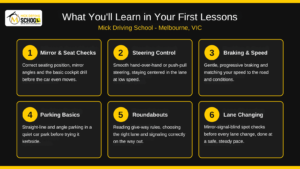
Beginner lessons build in a logical order, starting with vehicle control and moving toward decision-making in traffic. Here’s the general progression most Melbourne learners follow:
- Vehicle control – steering, braking, accelerating smoothly
- Parking – straight-line, angle and (later) parallel parking
- Roundabouts and give-way rules at intersections
- Lane changing and merging with proper mirror-signal checks
- Speed management and defensive driving in mixed traffic
- Hazard perception – anticipating what other road users might do
How Many Driving Lessons Do Most Beginners Need?
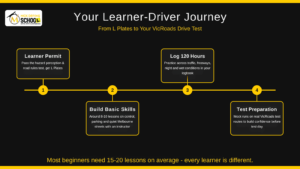
There’s no single answer, since every learner progresses differently depending on age, prior experience and how often they practice outside lessons. As a general guide, most beginners need somewhere between 15 and 20 professional lessons combined with regular practice toward their 120 logbook hours before they feel test-ready.
International licence holders often need fewer lessons focused specifically on Victorian road rules and local hazard perception, while first-time teenage learners typically benefit from a slower, more gradual build-up.
Tips to Learn Faster
- Practise little and often – two short sessions a week beats one long one
- Drive in a variety of conditions: day, night, wet weather and light traffic
- Ask your instructor for specific feedback after every lesson, not just at the end
- Keep a note of skills to revisit, and mention them at your next lesson
- Stay consistent – long gaps between lessons slow down muscle memory
How to Choose the Right Driving School in Melbourne
Choosing the best driving school in Melbourne comes down to a few practical factors, not just price. Consider:
- Fully licensed, experienced instructors with a calm, patient teaching style
- Dual-control vehicles for safety during early lessons
- Flexible scheduling that fits around school, work or family commitments
- Local knowledge of Melbourne’s roads, test centres and common hazard spots
- Transparent pricing with no hidden fees
A good driving instructor in Melbourne should feel like a coach, not a critic – someone who explains the ‘why’ behind every correction, not just the ‘what.’
Melbourne-Specific Driving Challenges
Learning to drive in Melbourne comes with a few local quirks worth knowing early:
- Hook turns – required at select CBD intersections to keep tram lines clear
- Trams – sharing lanes, stopping behind them at designated stops, and watching for pedestrians boarding or alighting
- Multi-lane roundabouts – common on arterial roads like those around the outer suburbs
- Variable speed zones – school zones and freeway speed changes that shift by time of day
- Congestion around the CBD and inner suburbs during peak hours
Instructors based locally, like our team at Mick Driving School, factor these Melbourne-specific conditions into lesson planning so nothing on test day feels unfamiliar.
Key Takeaways
- Your first lesson focuses on comfort, control and basic observation – not speed or traffic.
- Bring your learner permit, flat shoes and an open mindset.
- Most beginners need 15-20 lessons plus 120 logbook hours before testing.
- Common mistakes like gripping the wheel or skipping mirror checks are easy to fix early.
- Choosing an experienced, locally-based driving instructor in Melbourne makes test prep far less stressful.
Learning to drive is a gradual process, and every confident driver on Melbourne’s roads today once sat through their own first lesson feeling exactly as nervous as you might right now. With the right instructor, realistic expectations, and consistent practice, you’ll build the skills – and the confidence – to pass your VicRoads test and drive safely for years to come.
If you’re ready to get started, Mick Driving School offers beginner-friendly driving lessons across Melbourne, with experienced instructors, dual-control vehicles and flexible scheduling built around your life. Get in touch to book your first lesson and take the first step toward your licence.
Mick Driving School
15 Moore St, Moonee Ponds VIC 3039, Melbourne, Australia
Phone: 0424 558 850 | Email: mickdrivingschool@gmail.com | mickdrivingschool.com.au
Frequently Asked Questions
Q.1 How old do I need to be to start driving lessons in Victoria?
In Victoria, you can apply for your learner permit at 16 after passing the hazard perception and road rules tests, and you can begin lessons as soon as you hold your permit.
Q.2 Should I learn in a manual or automatic car?
Automatic is generally easier and faster to learn, since there’s no clutch control to master. Manual gives you the flexibility to drive either car type later, but takes longer to feel natural. Choose based on what you’re likely to drive day-to-day.
Q.3 How long is a typical driving lesson?
Most beginner lessons run for 60 to 90 minutes – long enough to build skills without overwhelming a new learner.
Q.4 Do I need to complete 120 logbook hours before my test?
Yes. VicRoads requires learner drivers under 21 to log 120 hours of supervised practice, including 10 hours of night driving, before booking their drive test.
Q.5 Can international licence holders convert straight to a full Victorian licence?
It depends on your country of origin and licence type. Some overseas licences convert directly, while others require Victorian-specific lessons and testing. It’s worth checking your eligibility with VicRoads directly.
Q.6 What’s the best way to prepare for the VicRoads driving test?
Practise on similar roads to the actual test route, focus on observation habits, and book a few lessons specifically for driving test preparation in Melbourne so an instructor can simulate real test conditions.
Q.7 Is it normal to feel nervous before my first lesson?
Completely normal. Almost every learner feels some nerves before lesson one. A patient instructor will adjust the pace to help you settle in quickly.
Q.8 How much does a driving lesson cost in Melbourne?
Pricing varies by school and lesson length. Package deals covering multiple lessons are usually more cost-effective than single bookings – it’s worth comparing options before committing.
Q.9 Can my parent or guardian teach me instead of a professional instructor?
Yes, supervised practice with a qualified driver counts toward your logbook hours. Many learners combine professional lessons with family practice for the best results.
Q.10 What happens if I fail my first VicRoads driving test?
You can rebook after a short waiting period. Many learners use the experience to identify specific weak points, then book a few refresher lessons before trying again.

